Use our Commission Calculator to quickly estimate sales commissions and earnings. Plan your sales strategy and track income accurately and efficiently.
Understanding how to calculate commissions correctly is essential for sales professionals, real estate agents, and business owners. Whether you’re determining sales commissions, real estate agent fees, or tiered commission structures, our comprehensive commission calculator makes the process simple and error-free. This guide explains everything you need to know about commission calculations while providing you with the tools to make accurate calculations every time.
Commission Calculator
Use our free calculator to determine commissions based on sales price, commission rate, or total commission amount. Perfect for sales professionals, real estate agents, and anyone working with commission-based income.

What is a Commission?
A commission is a form of payment that individuals earn based on the amount of products or services they sell. It’s typically calculated as a percentage of the sale price or profit and serves as a motivational tool to encourage salespeople to increase their sales performance.
Commissions are widely used across various industries, including real estate, retail, insurance, and financial services. The structure and rate of commissions can vary significantly depending on the industry, company policies, and individual agreements.
Why Commissions Matter
Commissions directly impact earnings for sales professionals and agents. Accurate calculation is essential for:
- Ensuring fair compensation
- Motivating sales performance
- Proper financial planning
- Accurate business expense tracking
- Transparent client relationships
Who Uses Commission Calculators
Our commission calculator is designed for:
- Real estate agents calculating transaction fees
- Sales managers determining team compensation
- Business owners creating commission structures
- Freelancers working with commission-based clients
- Financial planners projecting income
Different Commission Structures Explained
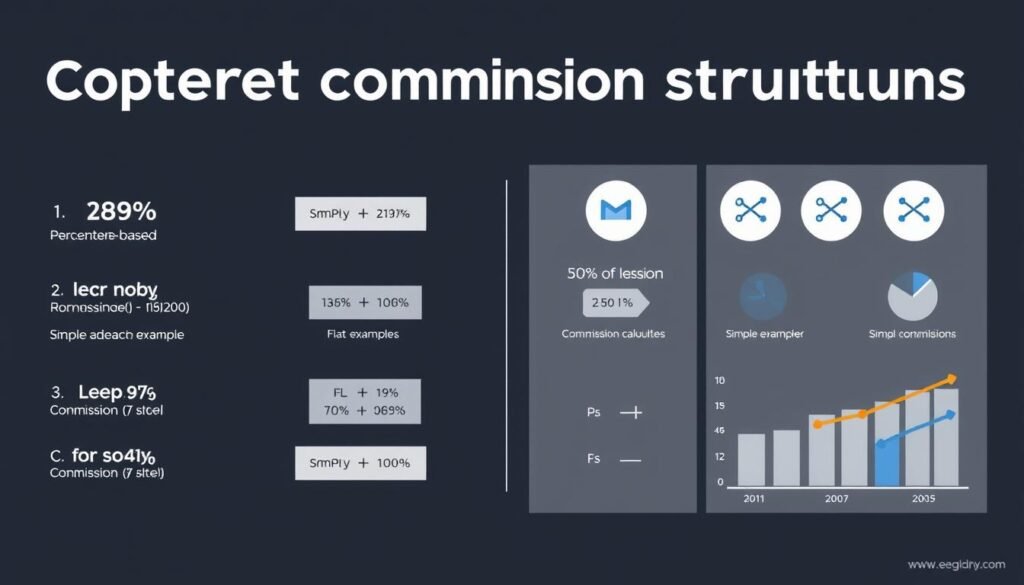
Understanding the various commission structures is crucial for accurately calculating payments. Each structure has its own formula and application. Our commission calculator supports all of these common structures.
Percentage-Based Commission
The most common structure where commission is calculated as a fixed percentage of the sale price. For example, a 5% commission on a $100,000 sale would yield $5,000.
Formula: Sale Price × Commission Percentage = Commission Amount
Tiered Commission
Commission rates change based on sales volume or value thresholds. Higher tiers typically offer increased commission percentages as an incentive for higher sales.
Example: 3% on first $20,000, 5% on $20,000-$50,000, 7% on amounts above $50,000
Base Salary Plus Commission
Combines a fixed base salary with commission earnings. This provides income stability while maintaining sales incentives.
Formula: Base Salary + (Sales × Commission Rate) = Total Compensation
Draw Against Commission
Salespeople receive an advance (draw) that is later deducted from earned commissions. This provides consistent income despite sales fluctuations.
Formula: Commission Earned – Draw Amount = Net Commission Payment
Split Commission
Commission is divided between multiple parties, such as between a buyer’s agent and seller’s agent in real estate transactions.
Formula: Total Commission ÷ Number of Parties = Commission Per Party
Flat Fee Commission
A fixed amount regardless of the sale price. Common in certain real estate transactions and specific product categories.
Example: $2,000 flat fee per transaction regardless of property value
Real Estate Commission Calculator
Real estate transactions involve specific commission calculations that differ from other industries. Typically, the total commission (usually 5-6% of the property’s selling price) is split between the listing agent and buyer’s agent, with further splits between agents and their brokerages.
Real Estate Commission Factors
- Property selling price
- Commission percentage (typically 5-6%)
- Agent/broker split (commonly 70/30 or 80/20)
- Dual agency considerations
- Referral fees (if applicable)
- Transaction fees and other deductions
How to Calculate Real Estate Commission
Follow these steps to calculate real estate commission:
- Determine the property’s selling price (e.g., $300,000)
- Multiply by the commission rate (e.g., 6% or 0.06)
- Calculate the total commission ($300,000 × 0.06 = $18,000)
- Divide between listing and buyer’s agents ($18,000 ÷ 2 = $9,000 each)
- Apply the agent/broker split (e.g., for 70/30 split: $9,000 × 0.7 = $6,300 for agent)
- Deduct any additional fees or costs
Our real estate commission calculator handles all these calculations automatically, saving you time and ensuring accuracy.

Sales Commission Calculator
Sales commissions vary widely across industries and companies. Our calculator helps sales professionals and managers accurately determine commission payments based on various structures and rates.
| Commission Type | Formula | Example | Best For |
| Straight Percentage | Sale Amount × Commission Rate | $10,000 sale × 5% = $500 commission | Simple transactions, clear incentives |
| Tiered Commission | Different rates at different thresholds | 3% on first $10K, 5% on $10K-$20K, 7% above $20K | Motivating higher sales volumes |
| Graduated Commission | Increasing rates for entire amount as thresholds are met | All sales at 7% once $50K threshold is reached | Rewarding top performers |
| Residual Commission | Percentage of recurring revenue | 2% of monthly subscription revenue | Subscription-based businesses |
Calculate Your Sales Commission
Our sales commission calculator handles all commission structures, including complex tiered and graduated models. Get accurate results instantly.
Tiered Commission Calculator
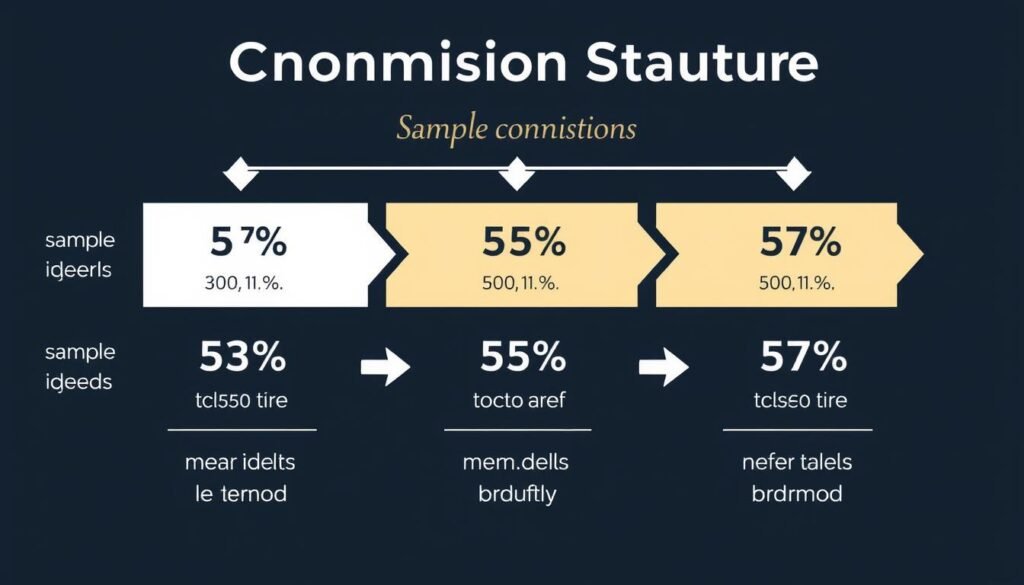
Tiered commission structures reward higher performance with increased commission rates at specific thresholds. These structures can be complex to calculate manually, which is why our tiered commission calculator is particularly valuable.
How Tiered Commissions Work
In a tiered commission structure, different commission rates apply to different sales ranges. For example:
- 3% commission on the first $20,000 in sales
- 5% commission on sales between $20,000 and $50,000
- 7% commission on sales above $50,000
If a salesperson achieves $60,000 in sales, their commission would be calculated as:
($20,000 × 3%) + ($30,000 × 5%) + ($10,000 × 7%) = $600 + $1,500 + $700 = $2,800
Benefits of Tiered Commissions
- Motivates salespeople to exceed targets
- Rewards top performers appropriately
- Creates clear performance milestones
- Aligns compensation with company revenue goals
- Provides scalable earning potential
Our tiered commission calculator handles these complex calculations automatically, ensuring accuracy and saving valuable time.
Essential Commission Calculation Formulas
Understanding the fundamental formulas for calculating different types of commissions is crucial for sales professionals, managers, and business owners. Our commission calculator incorporates all these formulas to provide accurate results.
Basic Commission Formula
The simplest commission calculation:
Commission = Sale Price × Commission Rate
Example: $10,000 sale with 5% commission
$10,000 × 0.05 = $500 commission
Split Commission Formula
For dividing commission between parties:
Individual Commission = Total Commission ÷ Number of Parties
Example: $1,000 commission split between two agents
$1,000 ÷ 2 = $500 per agent
Tiered Commission Formula
For calculating stepped commission rates:
Commission = (Tier 1 Amount × Rate 1) + (Tier 2 Amount × Rate 2) + …
Example: See tiered calculation example in previous section
Skip the Math, Use Our Calculator
Why struggle with complex formulas when our commission calculator can do the work for you? Get instant, accurate results for any commission structure.
Industry-Specific Commission Calculations
Commission structures vary significantly across industries. Our calculator is versatile enough to handle the unique requirements of various sectors.
Real Estate
Typically 5-6% of property value, split between listing and buyer’s agents, with further splits between agents and brokerages.
Key Consideration: Agent/broker splits typically range from 50/50 to 90/10 depending on experience and brokerage model.

Retail Sales
Often includes base salary plus commission (1-10% of sales), with potential bonuses for meeting targets.
Key Consideration: Commission rates may vary by product category, with higher margins allowing for higher commission rates.

Insurance
New policies typically earn 30-90% of first-year premium, with 3-10% renewal commissions in subsequent years.
Key Consideration: Residual commissions create long-term income streams from existing clients.

Financial Services
Varies widely from flat fees to percentage of assets under management (typically 0.5-1% annually).
Key Consideration: Regulatory requirements often impact commission structures and disclosure requirements.
Automotive Sales
Often includes mini (flat amount) plus percentage of dealer profit (typically 25-30%).
Key Consideration: Additional bonuses often available for volume targets and customer satisfaction scores.
Affiliate Marketing
Typically 5-30% of sales generated through affiliate links, with potential tiered structures for higher volume.
Key Consideration: Commission tracking through cookies with varying attribution windows (typically 7-90 days).
Industry-Specific Calculations Made Easy
Our commission calculator adapts to the unique requirements of your industry, providing accurate calculations regardless of your specific commission structure.
Best Practices for Commission Structures
Creating effective commission structures requires balancing business objectives with fair compensation. Here are key considerations for developing commission plans that motivate sales teams while supporting business goals.
For Businesses and Managers
- Align commission structures with company objectives
- Ensure transparency in calculation methods
- Set realistic yet motivating targets
- Consider team-based incentives alongside individual commissions
- Regularly review and adjust structures based on market conditions
- Provide tools (like commission calculators) to help sales staff understand their earnings
- Balance base salary and commission appropriately for your industry
For Sales Professionals
- Understand your commission structure thoroughly
- Track your sales and expected commissions regularly
- Use commission calculators to forecast earnings
- Identify highest-commission products or services
- Understand how tiered structures can accelerate earnings
- Consider total compensation package, not just commission rates
- Negotiate commission structures based on performance history

“The best commission structures align the interests of the company, the sales team, and the customer. When all three win, you’ve created a sustainable model for growth.”
Common Commission Calculation Mistakes to Avoid
Accurate commission calculations are essential for maintaining trust and motivation. Here are common mistakes to avoid when calculating commissions.
Best Practices
- Use automated tools like our commission calculator
- Document commission structures clearly
- Provide detailed commission statements
- Verify calculations before finalizing payments
- Keep comprehensive sales records
- Update commission rates in writing
- Consider tax implications in calculations
Common Mistakes
- Miscalculating tiered thresholds
- Overlooking split adjustments
- Applying incorrect commission rates
- Failing to account for returns or cancellations
- Inconsistent application of commission rules
- Manual calculation errors
- Delayed commission payments
Pro Tip: Using a dedicated commission calculator eliminates most common calculation errors and ensures consistency across all commission payments. Our calculator handles complex structures automatically, reducing the risk of costly mistakes.
Why Use Our Commission Calculator
Calculating commissions accurately is essential for sales professionals, real estate agents, managers, and business owners. Our comprehensive commission calculator offers several advantages:
Accuracy
Eliminate manual calculation errors and ensure precise commission figures every time. Our calculator handles even the most complex commission structures with ease.
Time-Saving
What might take hours to calculate manually can be done in seconds with our tool. Focus on selling rather than crunching numbers.
Versatility
Our calculator supports all commission structures including percentage-based, tiered, split, and industry-specific models.
Start Calculating Your Commissions Today
Join thousands of professionals who trust our commission calculator for accurate, hassle-free commission calculations.
For more financial tools, explore our financial calculators section, including our salary calculator and tax calculator.
Frequently Asked Questions About Commission Calculations
How is a basic commission calculated?
A basic commission is calculated by multiplying the sale price by the commission rate (expressed as a decimal). For example, a 5% commission on a ,000 sale would be: ,000 × 0.05 = 0.
What is a typical real estate commission rate?
Typical real estate commission rates in the United States range from 5% to 6% of the property’s selling price. This commission is usually split between the listing agent and buyer’s agent, with each receiving approximately half. The agents then typically split their portion with their respective brokerages.
How do tiered commission structures work?
Tiered commission structures apply different commission rates to different sales ranges. For example, a salesperson might earn 3% on the first ,000 in sales, 5% on sales between ,000 and ,000, and 7% on sales above ,000. Each tier is calculated separately and then added together for the total commission.
Are commissions taxable income?
Yes, commissions are considered taxable income in most countries, including the United States. They are typically taxed at the same rate as regular income. Sales professionals should set aside appropriate amounts for taxes or make estimated tax payments to avoid penalties.
Can commission structures be negotiated?
Yes, commission structures can often be negotiated, particularly in real estate and high-value sales positions. Experienced professionals with strong track records may be able to negotiate higher commission rates or more favorable structures. However, some industries have standard commission rates that are less flexible.