Use our Date Calculator to quickly find the difference between dates, add or subtract days, and more. Simple, accurate, and free online tool for all your date-related needs.
A date calculator is a powerful online tool that helps you determine the exact number of days, weeks, months, or years between two dates. It also allows you to add or subtract a specific time period from a given date. Whether you’re planning project timelines, calculating age, determining contract periods, or simply curious about how many days until your next vacation, a date calculator provides quick and accurate results without the hassle of manual calculations.
What is a Date Calculator?
A date calculator is a specialized computational tool designed to perform various date-related calculations with precision and ease. Unlike standard calculators that handle numerical operations, date calculators are programmed to work with calendar dates while accounting for varying month lengths, leap years, and other calendar complexities.
Need Quick Date Calculations?
Stop counting days manually and risking errors. Our date calculator handles all the complexity for you.
Most date calculators offer two primary functions:
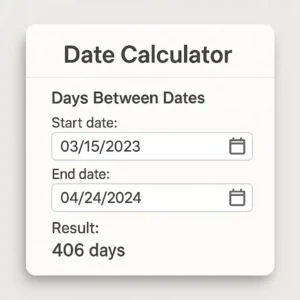
Days Between Dates
This function calculates the exact time span between two selected dates. The result typically shows the difference in days, but many calculators also convert this to years, months, and weeks for better context.
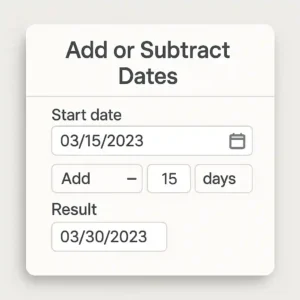
Add or Subtract Dates
This function allows you to start with a specific date and add or subtract a certain number of days, weeks, months, or years. It’s particularly useful for deadline calculations, contract periods, or planning future events.
Common Uses and Applications of Date Calculator
Date calculators serve numerous practical purposes across personal and professional contexts. Understanding these applications helps appreciate why these tools have become essential in our daily lives.
Personal Planning
- Calculating age precisely in years, months, and days
- Planning events and counting days until special occasions
- Determining pregnancy due dates
- Tracking anniversaries and milestones

Business Applications
- Project management and deadline calculations
- Employee time tracking and payroll periods
- Contract duration calculations
- Scheduling meetings and appointments

Legal and Financial Uses
- Calculating legal deadlines and court dates
- Determining interest periods for loans
- Computing tax filing deadlines
- Insurance policy period calculations

Save Time on Complex Date Calculations
Whether for business, personal planning, or legal deadlines, our date calculator handles all scenarios with precision.
How to Calculate Date Differences Manually
While online date calculators offer convenience, understanding how to perform date calculations manually provides valuable insight into the complexity these tools handle for you. Here are some methods for manual date calculations:
Simple Day Counting Method
For short periods within the same month:
- Identify your start and end dates
- Subtract the smaller date from the larger date
- Add 1 if you want to include both the start and end dates in your count
Example: From January 5 to January 12 = 12 – 5 = 7 days (or 8 days if including both start and end dates)
Counting Through Months
For periods spanning multiple months:
- Count the remaining days in the start month
- Count the days in all complete months between
- Add the days in the final month
Example: From January 28 to March 5:
- January: 31 – 28 = 3 days
- February: 28 days (in a non-leap year)
- March: 5 days
- Total: 3 + 28 + 5 = 36 days
Julian Day Method
For more complex calculations, especially spanning years:
- Convert both dates to Julian day numbers (the number of days since January 1, 4713 BCE)
- Subtract the smaller Julian day number from the larger one
This method requires conversion tables or formulas but provides exact results for any date range.
Remember: Manual calculations become significantly more complex when accounting for leap years, varying month lengths, and date formats. This is why date calculators are so valuable for ensuring accuracy.
Date Calculator Formulas and Methods
Behind every date calculator lies sophisticated algorithms that handle the complexities of our calendar system. Understanding these methods helps appreciate the value these calculators provide.
Gregorian Calendar Challenges
The Gregorian calendar, used worldwide today, presents several computational challenges:
- Months have varying lengths (28-31 days)
- February has 29 days in leap years
- Leap years occur in years divisible by 4, except century years not divisible by 400
These irregularities make simple day-counting formulas insufficient for accurate calculations.
Modern Calculation Methods
Modern date calculators typically use one of these approaches:
- Epoch-based calculation: Converting dates to days since a fixed reference date (like January 1, 1970)
- Date object manipulation: Using programming language date objects that handle calendar complexities
- Lookup tables: Referencing pre-computed values for common date calculations
These methods ensure accuracy while handling leap years and other calendar peculiarities.
Programming Implementation
In programming, date calculations often use:
- Unix timestamp (seconds since January 1, 1970)
- ISO 8601 date format (YYYY-MM-DD)
- Date libraries that handle timezone differences
- Functions that automatically adjust for Daylight Saving Time
These standardized approaches ensure consistent results across different platforms and applications.
Real-World Scenarios Where Date Calculations Are Essential
Date calculations play a crucial role in numerous real-world situations. Understanding these practical applications highlights why having a reliable date calculator is so valuable.
| Scenario | Date Calculation Needed | Why It Matters |
| Project Management | Deadline calculation, milestone planning | Ensures projects stay on schedule and resources are allocated properly |
| Legal Proceedings | Filing deadlines, statute of limitations | Missing legal deadlines can result in case dismissal or lost opportunities |
| Pregnancy | Due date calculation, trimester tracking | Helps in medical planning and monitoring fetal development stages |
| Financial Planning | Loan terms, investment maturity | Affects interest calculations and financial decision-making |
| Event Planning | Booking timelines, preparation schedules | Ensures all preparations are completed on time |
| Education | Semester planning, assignment deadlines | Helps students and institutions manage academic calendars |

“In my legal practice, accurate date calculations can make or break a case. Missing a filing deadline by even one day can have serious consequences for our clients. A reliable date calculator is an essential tool in our daily operations.”
Frequently Asked Questions About Date Calculations
How does a date calculator handle leap years?
Date calculators are programmed with the rules for determining leap years in the Gregorian calendar. They automatically account for the extra day (February 29) in years divisible by 4, except for century years not divisible by 400. This ensures accurate calculations even when your date range spans leap years.
Are working days calculations different from regular date calculations?
Yes. Working days calculations exclude weekends (typically Saturday and Sunday) and sometimes holidays. These calculations are more complex as they require knowledge of which days are considered non-working days in a particular country or organization. Specialized business date calculators often include options to exclude weekends and select holidays from the count.
How accurate are online date calculators?
High-quality online date calculators are extremely accurate. They implement sophisticated algorithms that account for all the complexities of the Gregorian calendar, including varying month lengths and leap years. However, it’s always good practice to verify critical date calculations using multiple tools, especially for legal or financial applications.
Can date calculators handle dates before the common era (BCE/BC)?
Some advanced date calculators can handle BCE dates, but many standard calculators are limited to Common Era (CE/AD) dates. When working with historical dates, especially those before the adoption of the Gregorian calendar in 1582, it’s important to use specialized historical date calculators that account for calendar system changes.
Do date calculators account for different time zones?
Basic date calculators typically don’t consider time zones as they work with calendar dates only. However, more sophisticated datetime calculators may include time zone functionality. When precise timing across time zones is important, look for calculators that specifically mention time zone handling capabilities.
How do I calculate age precisely using a date calculator?
To calculate age precisely, enter the birth date as the start date and the current date (or another reference date) as the end date. The calculator will show the exact age in years, months, and days. This is more accurate than the common method of simply subtracting birth year from the current year, which doesn’t account for whether the birthday has occurred yet in the current year.

Why Use Our Date Calculator?
Date calculations can quickly become complex when dealing with varying month lengths, leap years, and specific business requirements. Our date calculator eliminates the guesswork and potential for human error, providing you with instant, accurate results for any date-related calculation you need.
Benefits of Using Our Date Calculator
- Instant results without manual counting or calculation
- Perfect accuracy accounting for leap years and calendar complexities
- Multiple calculation types in one convenient tool
- User-friendly interface requiring no technical knowledge
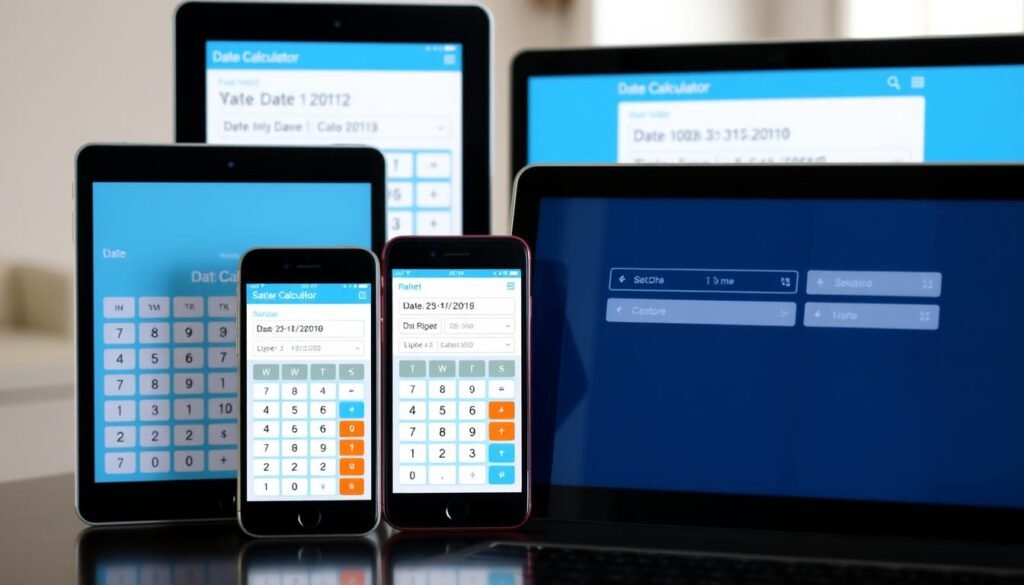
- Available 24/7 from any device with internet access
- Free to use with no registration required
Ready to Simplify Your Date Calculations?
Stop counting days manually or struggling with complex calendar rules. Our date calculator gives you precise results instantly.