Finding the greatest common factor (GCF) is a fundamental mathematical operation with numerous practical applications. Whether you’re simplifying fractions, factoring polynomials, or solving real-world math problems, knowing how to calculate the GCF efficiently is essential. This comprehensive guide explains what the greatest common factor is, why it matters, and provides step-by-step methods to find it manually or with our calculator tool.
What is the Greatest Common Factor?
Visual representation of the Greatest Common Factor concept
The Greatest Common Factor (GCF), also known as the Greatest Common Divisor (GCD) or Highest Common Factor (HCF), is the largest positive integer that divides two or more numbers without leaving a remainder. In other words, it’s the largest number that is a factor of all the given numbers.
For example, the factors of 12 are 1, 2, 3, 4, 6, and 12. The factors of 18 are 1, 2, 3, 6, 9, and 18. The common factors are 1, 2, 3, and 6. Therefore, the greatest common factor of 12 and 18 is 6.
Why Finding the Greatest Common Factor Matters
The greatest common factor is a fundamental concept in mathematics with numerous practical applications. Understanding how to find the GCF quickly and accurately can help you:
- Simplify fractions to their lowest terms
- Factor algebraic expressions and polynomials
- Solve problems involving common groupings or divisions
- Understand number relationships and properties
- Perform efficient calculations in various mathematical operations

Save Time with Our GCF Calculator
Finding the GCF manually can be time-consuming, especially with large numbers. Our calculator provides instant, accurate results for any set of numbers.
Methods to Find the Greatest Common Factor
There are several approaches to finding the greatest common factor of two or more numbers. Each method has its advantages depending on the size and quantity of numbers you’re working with.
Method 1: Listing All Factors
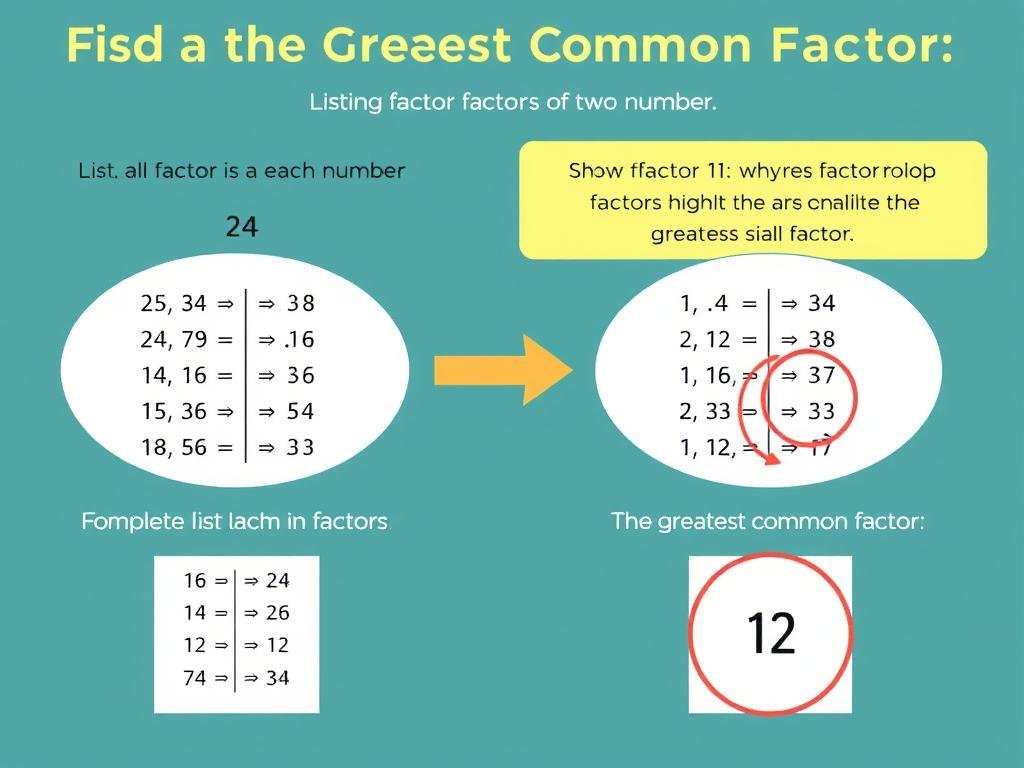
The most straightforward approach to finding the GCF is to list all factors of each number and identify the largest common factor:
- List all factors of the first number
- List all factors of the second number
- Identify all common factors from both lists
- Select the largest common factor as the GCF
Example: Find the GCF of 24 and 36
Factors of 24: 1, 2, 3, 4, 6, 8, 12, 24
Factors of 36: 1, 2, 3, 4, 6, 9, 12, 18, 36
Common factors: 1, 2, 3, 4, 6, 12
The greatest common factor is 12.
Method 2: Prime Factorization

Prime factorization is often more efficient, especially for larger numbers:
- Break down each number into its prime factors
- Identify the common prime factors
- Multiply the common prime factors to find the GCF
Example: Find the GCF of 48 and 72
Prime factorization of 48: 24 × 3 = 2 × 2 × 2 × 2 × 3
Prime factorization of 72: 23 × 32 = 2 × 2 × 2 × 3 × 3
Common prime factors: 23 × 3 = 2 × 2 × 2 × 3 = 24
The greatest common factor is 24.
Finding GCF for Multiple Numbers?
Our calculator can handle up to 15 numbers at once, saving you time and ensuring accuracy.
Method 3: Euclidean Algorithm

The Euclidean algorithm is particularly efficient for large numbers:
- Divide the larger number by the smaller number
- Replace the larger number with the smaller number
- Replace the smaller number with the remainder from step 1
- Repeat until the remainder is zero
- The GCF is the last non-zero remainder
Example: Find the GCF of 105 and 45
105 ÷ 45 = 2 with remainder 15
45 ÷ 15 = 3 with remainder 0
Since the remainder is now 0, the GCF is 15.
Method 4: Subtraction Method

The subtraction method is a variation of the Euclidean algorithm:
- Compare the two numbers
- Subtract the smaller number from the larger number
- Replace the larger number with the result of the subtraction
- Repeat until both numbers are equal
- The GCF is the value of the equal numbers
Example: Find the GCF of 48 and 18
48 – 18 = 30
30 – 18 = 12
18 – 12 = 6
12 – 6 = 6
Since both numbers are now equal (6), the GCF is 6.
Key Properties of the Greatest Common Factor
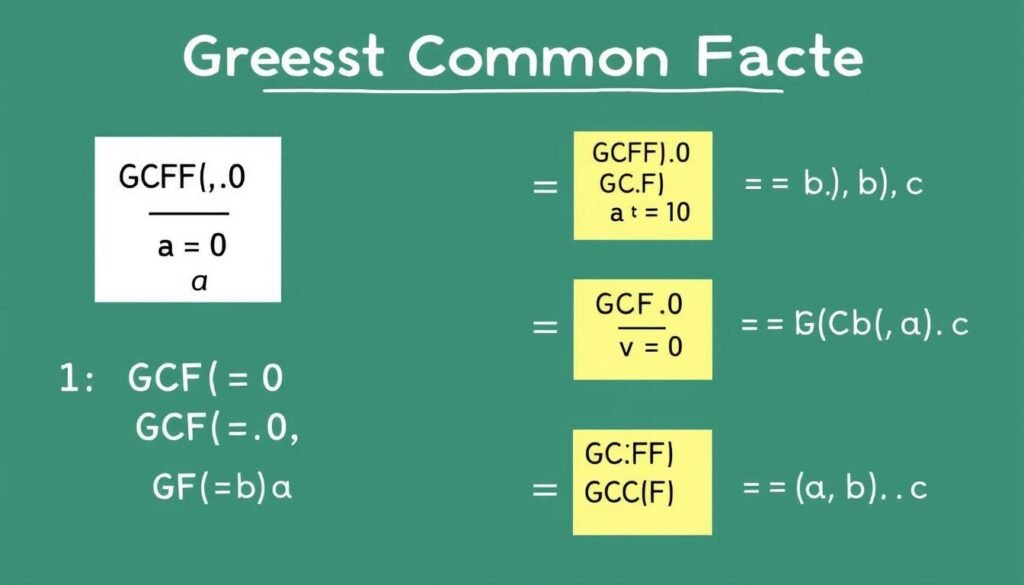
Basic Properties
- The GCF of any number and zero is the number itself: GCF(a,0) = a
- The GCF of any number and one is always one: GCF(a,1) = 1
- The GCF of a number and itself is the number: GCF(a,a) = a
Advanced Properties
- The GCF of two prime numbers is always 1
- If a divides b evenly, then GCF(a,b) = a
- For three or more numbers: GCF(a,b,c) = GCF(GCF(a,b),c)
Complex GCF Calculations Made Simple
Working with large numbers or multiple values? Our calculator handles complex GCF calculations instantly.
Finding the GCF of Three or More Numbers

To find the GCF of three or more numbers, you can extend any of the methods described above. The most efficient approach is to:
- Find the GCF of the first two numbers
- Find the GCF of the result and the third number
- Continue this process for any additional numbers
Example: Find the GCF of 24, 36, and 60
First, find GCF(24, 36) = 12
Then, find GCF(12, 60) = 12
Therefore, the GCF of 24, 36, and 60 is 12.
Practical Applications of the Greatest Common Factor

Mathematics
- Simplifying fractions to lowest terms
- Factoring algebraic expressions
- Finding the least common multiple (LCM)
Computer Science
- Cryptography algorithms
- Computer graphics (scaling)
- Data compression techniques
Everyday Life
- Dividing items equally among groups
- Determining optimal packaging sizes
- Creating equal time intervals
Calculate Any GCF Instantly
Stop struggling with manual calculations. Our Greatest Common Factor Calculator provides immediate, accurate results for any set of numbers.
Frequently Asked Questions About Greatest Common Factor
What is the difference between GCF and LCM?
The Greatest Common Factor (GCF) is the largest positive integer that divides two or more numbers without a remainder. The Least Common Multiple (LCM) is the smallest positive integer that is divisible by two or more numbers. While GCF finds the largest shared factor, LCM finds the smallest shared multiple.
How do I find the GCF of three numbers?
To find the GCF of three numbers, first find the GCF of any two numbers, then find the GCF of that result and the third number. For example, to find the GCF of 12, 18, and 24, first calculate GCF(12,18) = 6, then calculate GCF(6,24) = 6. Therefore, the GCF of 12, 18, and 24 is 6.
Can the GCF of two numbers be larger than either number?
No, the GCF of two numbers cannot be larger than either of the numbers. By definition, the GCF is a factor of both numbers, and a factor cannot be larger than the number itself.
What is the GCF of two prime numbers?
The GCF of two different prime numbers is always 1, because prime numbers have only two factors: 1 and the number itself. Since they don’t share any common factors except 1, their GCF is 1.
How is the GCF related to simplifying fractions?
The GCF is used to simplify fractions to their lowest terms. By dividing both the numerator and denominator by their GCF, you obtain an equivalent fraction in its simplest form. For example, to simplify 24/36, find GCF(24,36) = 12, then divide both numbers by 12 to get 2/3.
Conclusion
The greatest common factor is a fundamental mathematical concept with wide-ranging applications. While there are several methods to calculate the GCF manually, each with its advantages depending on the numbers involved, using a dedicated calculator can save time and ensure accuracy, especially when working with large or multiple numbers.
Our Greatest Common Factor Calculator provides instant results for any set of numbers, allowing you to focus on applying the concept rather than performing tedious calculations. Whether you’re a student, teacher, or professional, our calculator is designed to make your mathematical work more efficient and error-free.
Ready to Calculate GCF Effortlessly?
Try our free Greatest Common Factor Calculator now and get instant, accurate results for any set of numbers.