Understanding molarity is fundamental in chemistry for creating solutions with precise concentrations. While many online tools can perform these calculations automatically, mastering the underlying concepts and formulas empowers you to work confidently in laboratory settings. This comprehensive guide explains everything you need to know about molarity, from basic definitions to practical calculation examples, helping you solve concentration problems with ease.
What is Molarity?
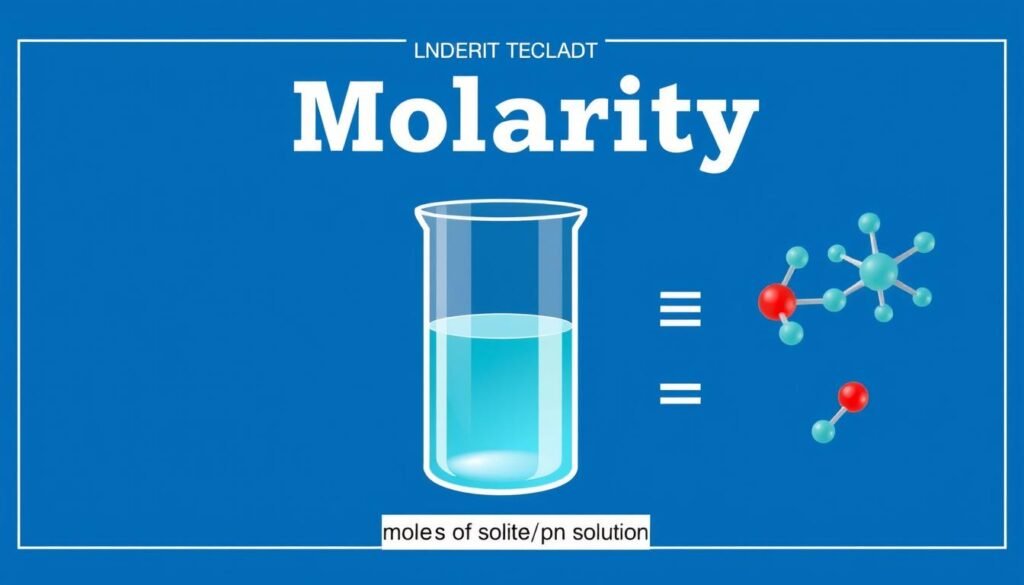
Molarity (M) is a measure of concentration that represents the number of moles of solute per liter of solution. It is one of the most commonly used expressions of concentration in chemistry and is essential for preparing solutions of specific strengths. Molarity provides a standardized way to describe solution concentration regardless of the specific substance being dissolved.
The standard unit for molarity is moles per liter (mol/L), which is often abbreviated simply as “M” (pronounced “molar”). For example, a 1M solution contains 1 mole of solute per liter of solution, while a 0.5M solution contains 0.5 moles of solute per liter of solution.
Molarity is particularly useful because it directly relates the amount of substance (in moles) to the volume of solution, making it ideal for stoichiometric calculations in chemical reactions.
The Molarity Formula

The standard formula for calculating molarity is:
Molarity (M) = Moles of solute / Volume of solution (in liters)
This formula can be broken down into its components:
- Molarity (M): The concentration of the solution in moles per liter (mol/L)
- Moles of solute: The amount of the dissolved substance, measured in moles
- Volume of solution: The total volume of the solution (not just the solvent), measured in liters
It’s important to note that the volume refers to the entire solution, not just the volume of solvent used. This is because molarity describes the concentration of the complete mixture.
Master Chemistry Calculations
Get our free Molarity Formula Cheat Sheet with quick reference guides and practice problems.
How to Calculate Molarity
Calculating molarity involves several steps, depending on what information you have available. Here’s a step-by-step guide to the most common molarity calculations:
Method 1: When You Know Moles and Volume
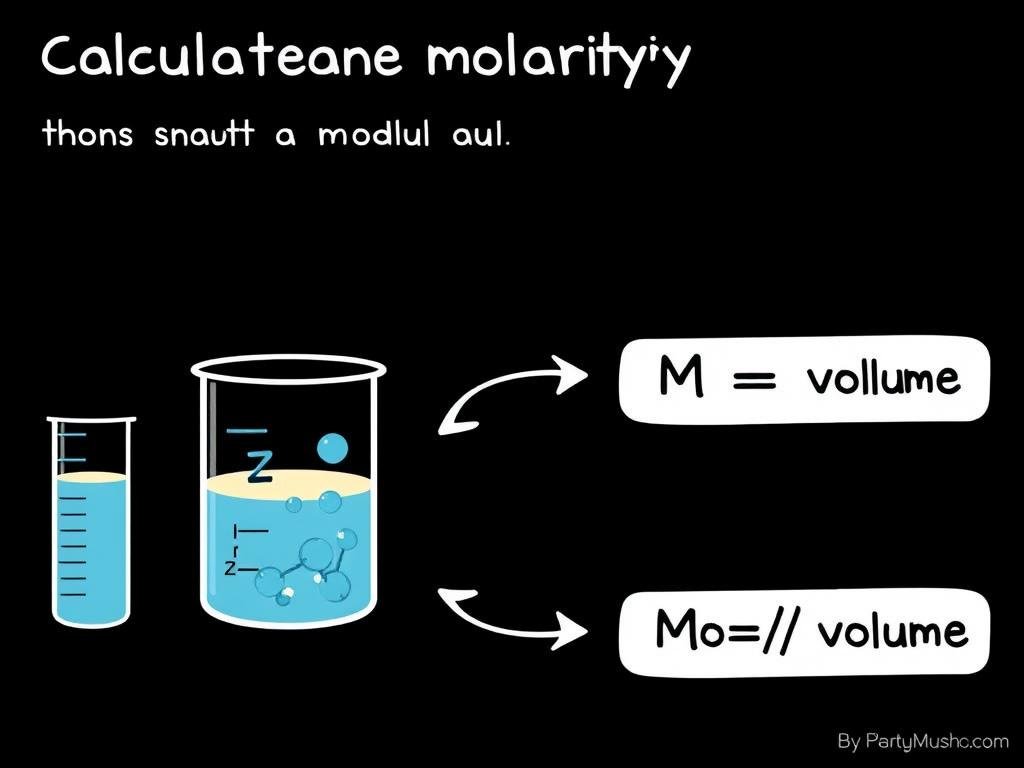
- Determine the number of moles of solute
- Measure the total volume of the solution in liters
- Divide the moles of solute by the volume in liters
Example: If you dissolve 0.5 moles of NaCl in enough water to make 2 liters of solution, the molarity would be:
M = 0.5 mol / 2 L = 0.25 M
This means you have a 0.25 molar solution of sodium chloride.
Method 2: When You Know Mass, Molecular Weight, and Volume
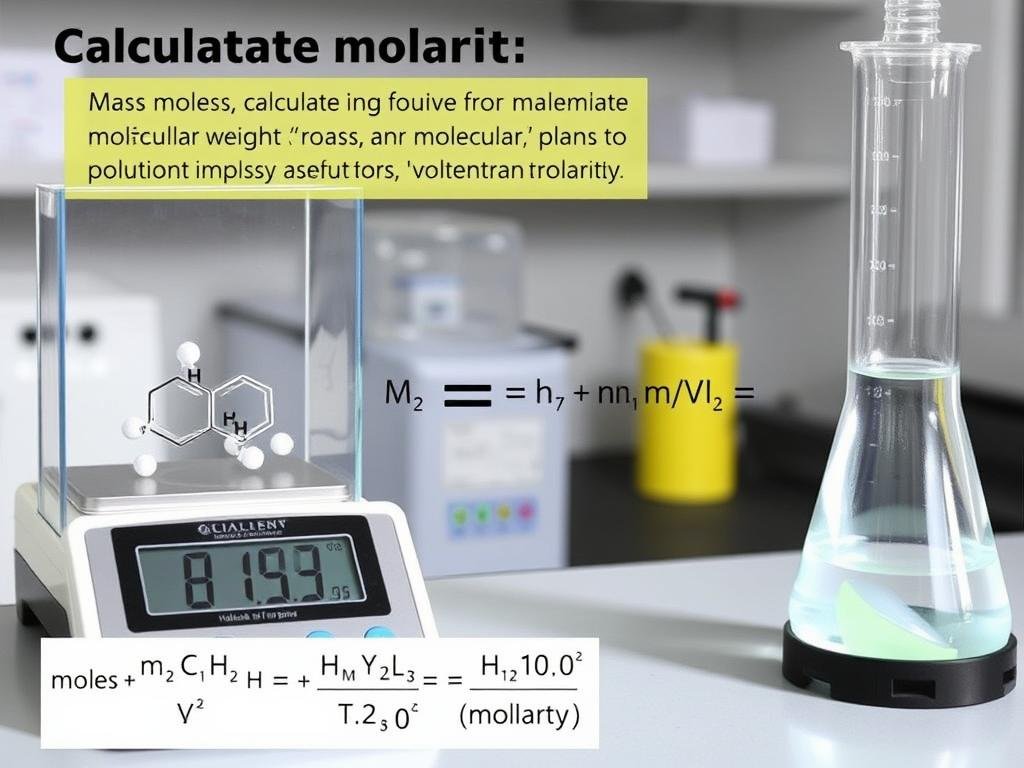
Often, you’ll have the mass of a substance rather than moles. In this case:
- Determine the mass of the solute in grams
- Find the molecular weight (molar mass) of the solute in g/mol
- Calculate moles by dividing mass by molecular weight
- Measure the total volume of the solution in liters
- Divide the moles of solute by the volume in liters
This can be expressed as a single formula:
Molarity (M) = Mass of solute (g) / [Molecular weight (g/mol) × Volume (L)]
Example: Calculate the molarity of a solution prepared by dissolving 5.85 g of NaCl (molecular weight = 58.5 g/mol) in enough water to make 500 mL of solution.
Step 1: Convert mass to moles
Moles of NaCl = 5.85 g / 58.5 g/mol = 0.1 mol
Step 2: Convert volume to liters
Volume = 500 mL = 0.5 L
Step 3: Calculate molarity
M = 0.1 mol / 0.5 L = 0.2 M
Units of Molarity and Related Concentrations
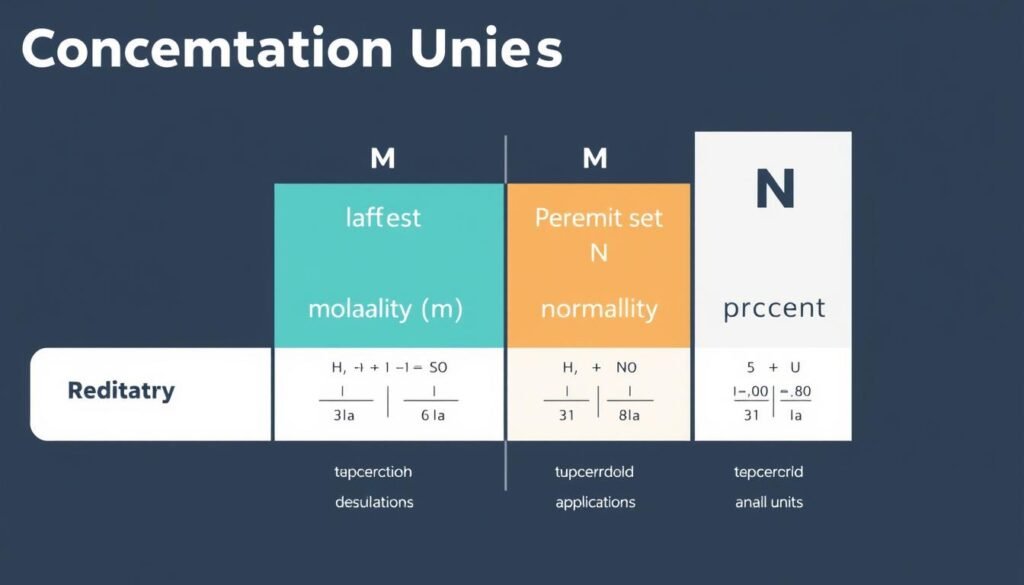
While the standard unit for molarity is moles per liter (mol/L) or simply M, there are several related units and expressions of concentration that you might encounter:
Standard Molarity Units
- Molar (M): mol/L (standard unit)
- Millimolar (mM): mmol/L (1 mM = 0.001 M)
- Micromolar (μM): μmol/L (1 μM = 0.000001 M)
- Nanomolar (nM): nmol/L (1 nM = 0.000000001 M)
Related Concentration Units
- Molality (m): Moles of solute per kilogram of solvent
- Normality (N): Gram equivalents of solute per liter of solution
- Percent concentration: Mass/volume (w/v), mass/mass (w/w), or volume/volume (v/v)
Understanding the differences between these units is crucial for accurate solution preparation and for interpreting scientific literature correctly.
Why is Molarity Important?

Molarity is a fundamental concept in chemistry with numerous practical applications:
Solution Preparation
Molarity allows chemists to prepare solutions with precise concentrations, which is essential for reproducible experiments and accurate results in laboratory work.
Stoichiometric Calculations
In chemical reactions, molarity helps determine the amounts of reactants needed and products formed, making it crucial for predicting reaction outcomes.
Titration Analysis
Titrations rely on solutions of known molarity to determine the concentration of unknown solutions, forming the basis of many analytical chemistry techniques.
Beyond these applications, molarity is essential in pharmaceuticals for medication dosing, in biochemistry for buffer preparation, and in environmental testing for measuring pollutant concentrations.
Related Terms and Concepts
| Term | Definition | Formula | Key Difference from Molarity |
| Molality | Moles of solute per kilogram of solvent | m = moles of solute / kg of solvent | Based on mass of solvent, not volume of solution; not affected by temperature |
| Normality | Gram equivalents per liter of solution | N = gram equivalents / liter of solution | Accounts for reactive capacity in acid-base or redox reactions |
| Mole | SI unit representing 6.022 × 10²³ particles | n = mass / molar mass | A quantity, not a concentration |
| Percent Concentration | Parts of solute per 100 parts of solution | % (w/v) = (g of solute / mL of solution) × 100 | Based on mass or volume ratios, not moles |
Solute vs. Solvent
Solute: The substance being dissolved in a solution. In molarity calculations, this is the compound whose concentration we’re expressing.
Solvent: The substance that does the dissolving. In laboratory settings, water is the most common solvent, but others like ethanol or acetone may be used.
Understanding these related concepts helps provide a complete picture of solution chemistry and allows for conversion between different concentration units as needed for specific applications.
Frequently Asked Questions About Molarity

What is the difference between molarity and molality?
Molarity (M) is defined as moles of solute per liter of solution, while molality (m) is defined as moles of solute per kilogram of solvent. The key difference is that molarity depends on volume (which changes with temperature), while molality depends on mass (which remains constant regardless of temperature). For dilute aqueous solutions at room temperature, the numerical values of molarity and molality are often very similar.
How do you find moles from molarity?
To find moles from molarity, rearrange the molarity formula: Moles = Molarity × Volume (in liters). For example, if you have 0.5 liters of a 2M solution, the number of moles would be: 2 mol/L × 0.5 L = 1 mol.
Can molarity be negative?
No, molarity cannot be negative. Since molarity represents the physical quantity of substance per unit volume, it must be a positive value or zero. A negative number of moles or negative volume doesn’t have physical meaning in this context.
How do you prepare a solution of specific molarity?
To prepare a solution of specific molarity:
- Calculate the mass of solute needed using: Mass = Molarity × Volume (in L) × Molecular Weight
- Weigh out the calculated mass of solute
- Dissolve the solute in less than the final volume of solvent
- Transfer to a volumetric flask and add solvent until reaching the calibration mark
- Mix thoroughly to ensure uniform concentration
What happens to molarity when you dilute a solution?
When you dilute a solution, the molarity decreases because the same number of moles is distributed in a larger volume. The relationship follows the dilution equation: M₁V₁ = M₂V₂, where M₁ and V₁ are the initial molarity and volume, and M₂ and V₂ are the final molarity and volume. This equation reflects that the number of moles remains constant during dilution.
What is the molarity of pure water?
The molarity of pure water is approximately 55.5 M. This can be calculated by dividing the density of water (1000 g/L) by its molecular weight (18.02 g/mol): 1000 g/L ÷ 18.02 g/mol = 55.5 mol/L. This high molarity reflects the fact that water is very concentrated when considered as a solute in itself.
Mastering Molarity Calculations

Understanding molarity is essential for anyone working in chemistry, biology, pharmacy, or related fields. By mastering the molarity formula and calculation methods outlined in this guide, you’ll be equipped to prepare solutions accurately, predict reaction outcomes, and interpret concentration data with confidence.
Remember that practice is key to becoming proficient with molarity calculations. Start with simple examples and gradually work your way to more complex scenarios involving dilutions, titrations, and mixed solutions.
Take Your Chemistry Skills to the Next Level
Download our comprehensive Chemistry Calculations Guide covering molarity, molality, normality, and more with practice problems and solutions.