Voltage drop is a critical concept in electrical design that affects system performance, efficiency, and safety. When current flows through wires, some voltage is lost due to the wire’s resistance. This loss, known as voltage drop, can lead to equipment malfunction, energy waste, and even fire hazards if not properly calculated and managed. Our comprehensive guide explains voltage drop calculations, formulas, and practical applications to help electricians, engineers, and DIY enthusiasts ensure their electrical systems operate safely and efficiently.
What is Voltage Drop?
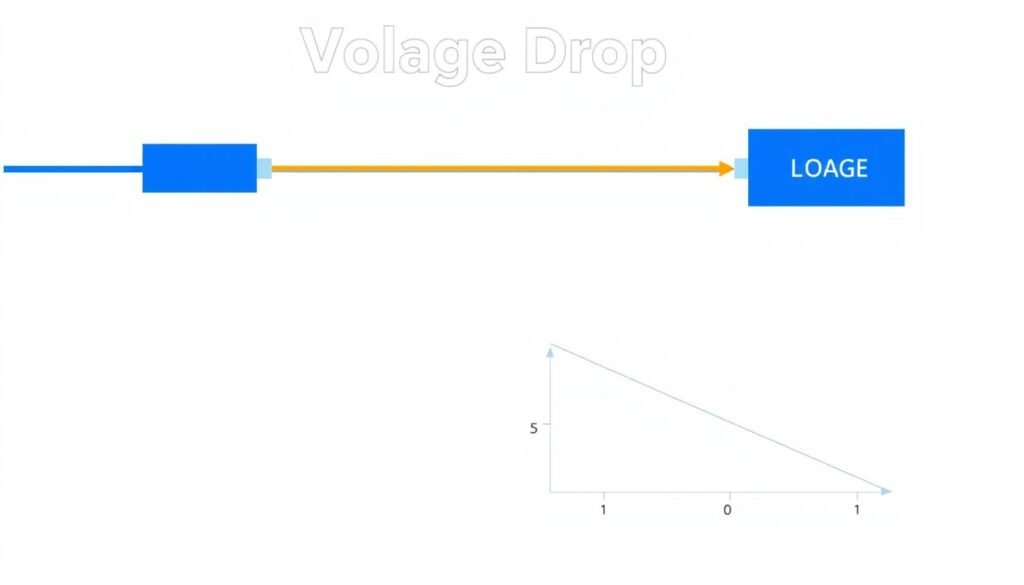
Voltage drop refers to the reduction in electrical potential along a wire carrying current. As electricity travels through conductors, it encounters resistance that converts some electrical energy into heat. This resistance causes a decrease in voltage between the source and the load, which is measured in volts (V) or as a percentage of the source voltage.
The primary causes of voltage drop include:
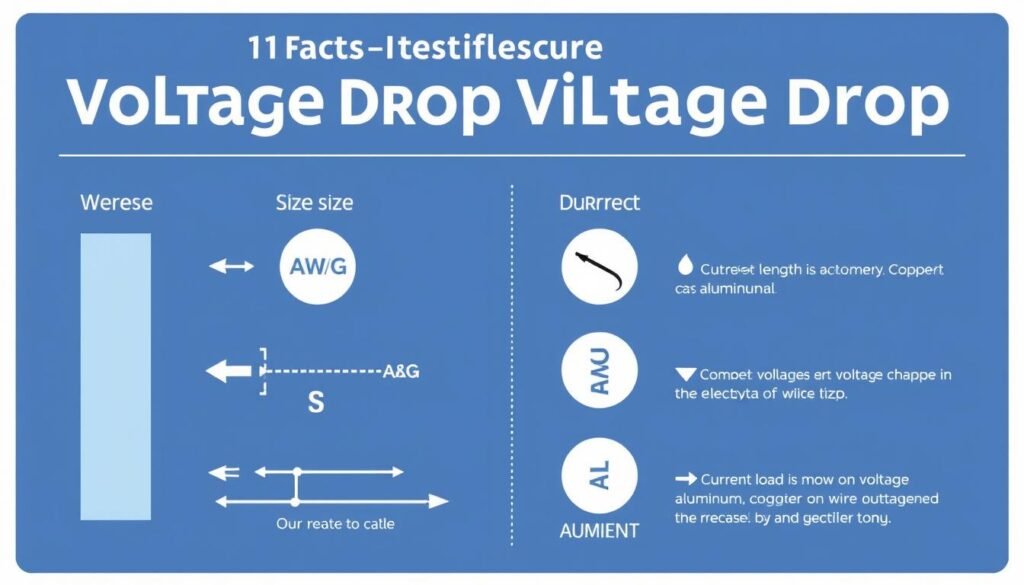
- Wire Material: Different conductor materials have varying resistivity. Copper has lower resistivity than aluminum, resulting in less voltage drop for the same wire size and length.
- Wire Size: Smaller wire gauges (higher AWG numbers) have greater resistance and cause more voltage drop. Larger wires (lower AWG numbers) reduce voltage drop.
- Wire Length: Longer wires create more resistance and increase voltage drop. Doubling the wire length doubles the voltage drop.
- Current Load: Higher current flow through a wire increases voltage drop. The relationship is linear—doubling the current doubles the voltage drop.
Excessive voltage drop can cause serious problems in electrical systems, including:
- Dimming lights and flickering
- Motors running slower and hotter than normal
- Reduced efficiency of heating elements
- Electronic equipment malfunction
- Increased energy consumption
- Potential fire hazards from overheating
Need Quick Voltage Drop Calculations?
Sign up for free access to our online voltage drop calculator and simplify your electrical planning.
Why Calculate Voltage Drop?

Calculating voltage drop is essential for several important reasons:
Electrical Code Compliance
The National Electrical Code (NEC) recommends limiting voltage drop to 3% for branch circuits and 5% for the combined feeder and branch circuit. These standards ensure electrical systems operate within safe parameters. Failing to meet these requirements can result in code violations and failed inspections.
Equipment Performance
Electrical equipment is designed to operate at specific voltage levels. Excessive voltage drop can cause equipment to perform poorly, reduce its lifespan, or fail completely. Motors may not start properly, heaters may not reach desired temperatures, and electronic devices may malfunction or reset unexpectedly.
Energy Efficiency
Voltage drop represents energy that is wasted as heat in the conductors rather than being used by the intended load. This wasted energy increases electricity costs and reduces system efficiency. Proper voltage drop calculations help optimize energy usage and reduce operating costs.
Safety Considerations
Excessive voltage drop can lead to overheating of conductors, which increases fire risk. It can also cause equipment to draw more current than intended, potentially overloading circuits. Proper voltage drop calculations are a critical part of electrical safety planning.
The Voltage Drop Formulas
DC and Single-Phase AC Formula
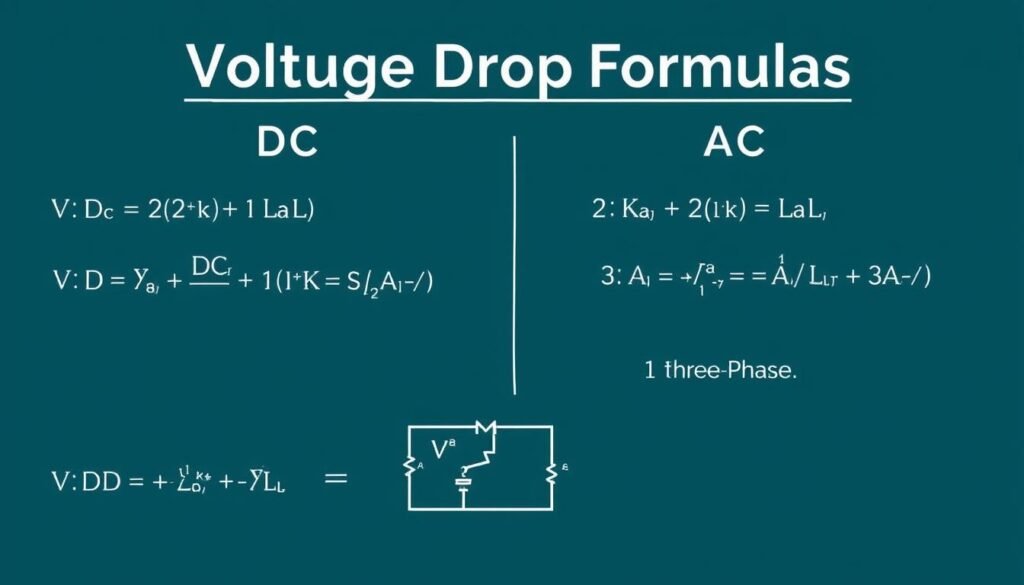
For DC circuits and single-phase AC circuits, the voltage drop can be calculated using the following formula:
VD = (2 × K × I × L) / CMA
Where:
- VD = Voltage Drop (Volts)
- K = Resistivity of the conductor material (12.9 for copper, 21.2 for aluminum)
- I = Current (Amperes)
- L = One-way length of the wire (Feet)
- CMA = Cross-sectional area of the conductor (Circular Mils)
Three-Phase AC Formula
For three-phase AC circuits, the voltage drop formula is slightly different:
VD = (√3 × K × I × L) / CMA
Where the variables are the same as in the single-phase formula, but √3 (approximately 1.732) accounts for the three-phase configuration.
Percentage Voltage Drop
Often, voltage drop is expressed as a percentage of the source voltage:
% VD = (VD / Vsource) × 100
Where:
- % VD = Percentage Voltage Drop
- VD = Calculated Voltage Drop (Volts)
- Vsource = Source Voltage (Volts)
Simplify Your Electrical Calculations
Our online calculator handles all these formulas automatically. Try it now to save time and ensure accuracy.
How to Calculate Voltage Drop – A Step-by-Step Guide
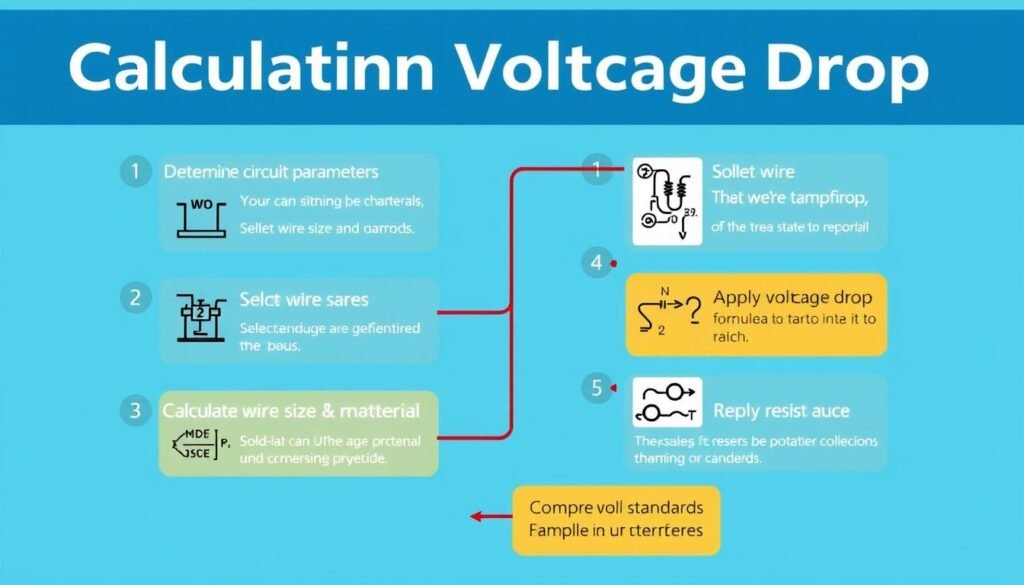
Follow these steps to manually calculate voltage drop in an electrical circuit:
-
Determine the circuit parameters:
Identify the source voltage (V), current (I), and whether it’s a DC, single-phase AC, or three-phase AC system.
-
Measure the wire length:
Measure the one-way distance (L) from the power source to the load in feet or meters.
-
Identify the wire size and material:
Determine the wire gauge (AWG) and whether it’s made of copper or aluminum.
-
Find the wire’s cross-sectional area:
Convert the AWG to circular mils (CMA) using a wire size chart or the formula: CMA = 0.025 × 92(36-n)/19.5 where n is the AWG number.
-
Apply the appropriate voltage drop formula:
Use the DC/single-phase or three-phase formula as needed.
-
Calculate the percentage voltage drop:
Divide the voltage drop by the source voltage and multiply by 100.
-
Compare to standards:
Check if the calculated voltage drop percentage is within acceptable limits (typically 3% for branch circuits and 5% for combined feeder and branch circuits).
Example Calculation
Let’s work through a practical example of calculating voltage drop:
Problem:
Calculate the voltage drop for a 100-foot run of 12 AWG copper wire carrying 15 amps in a 120V single-phase circuit.
Solution:
- Circuit parameters: 120V single-phase AC, 15 amps
- Wire length: 100 feet (one-way)
- Wire size and material: 12 AWG copper
- Cross-sectional area: 12 AWG copper = 6,530 circular mils
- Apply the formula: VD = (2 × 12.9 × 15 × 100) / 6,530
- Calculate: VD = (38,700) / 6,530 = 5.93 volts
- Calculate percentage: % VD = (5.93 / 120) × 100 = 4.94%
Conclusion:
The voltage drop is 5.93 volts or 4.94%. This exceeds the NEC recommendation of 3% for branch circuits. To reduce the voltage drop, you could use a larger wire size (10 AWG or 8 AWG) or reduce the circuit length if possible.
Factors Affecting Voltage Drop
Wire Size (AWG)
Wire size has a significant impact on voltage drop. Larger wires (smaller AWG numbers) have less resistance and therefore less voltage drop. For example, 10 AWG wire has approximately 37% less resistance than 12 AWG wire. When voltage drop is excessive, increasing the wire size is often the most effective solution.
Wire Material
The conductor material affects voltage drop through its resistivity. Copper has a resistivity of approximately 12.9 ohms per circular mil-foot, while aluminum has a higher resistivity of about 21.2 ohms per circular mil-foot. This means aluminum wire will have approximately 64% more voltage drop than copper wire of the same size and length.
Circuit Length
Voltage drop increases linearly with circuit length. Doubling the wire length doubles the voltage drop. This is why voltage drop becomes a critical consideration in long-distance power transmission and in applications where equipment is far from the power source, such as outbuildings or landscape lighting.
Current Load
Voltage drop is directly proportional to the current flowing through the wire. Doubling the current doubles the voltage drop. This is why circuits with high-current loads, such as motors, heaters, and large appliances, are more susceptible to voltage drop issues and often require larger wire sizes.
Temperature
Wire resistance increases with temperature, which in turn increases voltage drop. The standard resistivity values used in calculations are typically specified at 75°C (167°F). In high-temperature environments, the actual voltage drop may be higher than calculated using standard values.
Power Factor
In AC circuits, the power factor affects the relationship between current and voltage. A lower power factor means more current is needed for the same power delivery, which increases voltage drop. This is particularly important in industrial settings with large motors and other inductive loads.
How to Reduce Voltage Drop
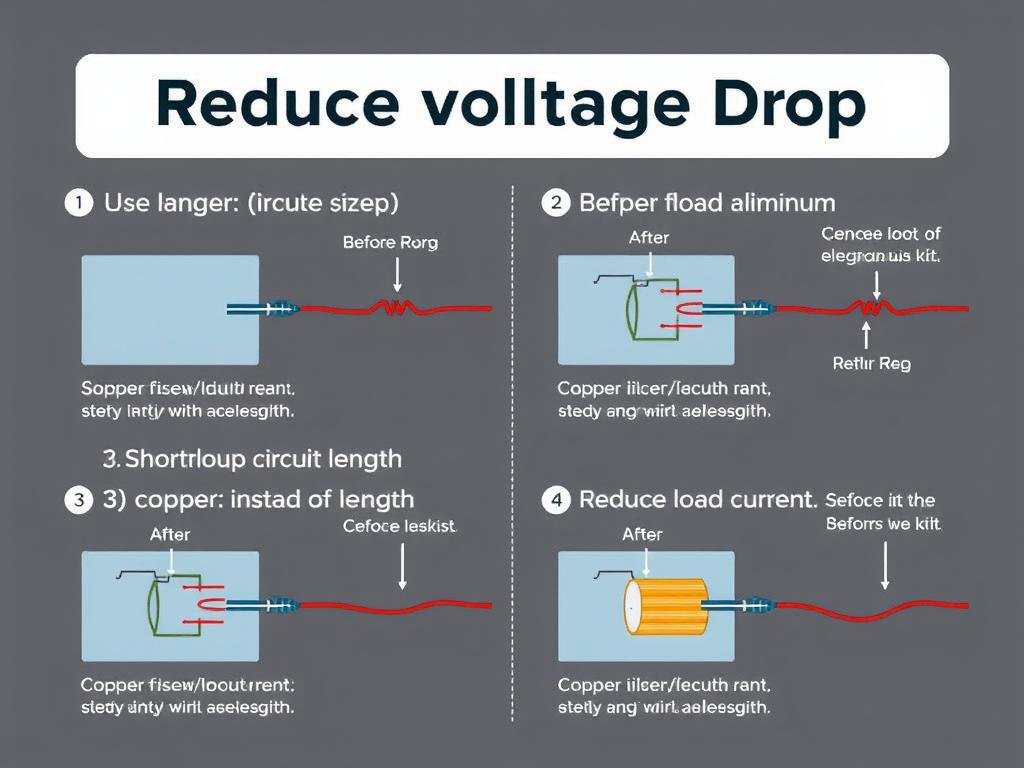
When voltage drop exceeds acceptable limits, several strategies can be employed to reduce it:
- Use a larger gauge wire (smaller AWG number)
- Most effective method for reducing voltage drop
- May increase material and installation costs
- Often the simplest solution for new installations
Increase Wire Size
- Relocate power sources closer to loads
- Use multiple power sources for distributed loads
- Reorganize circuit layout to minimize wire runs
- May not be practical in existing installations
Reduce Circuit Length
- Use copper instead of aluminum when possible
- Copper has approximately 40% less resistance
- Higher material cost but better performance
- Consider corrosion and connection issues
Change Conductor Material
Optimize Your Electrical Design
Our voltage drop calculator helps you determine the ideal wire size for your application, saving time and preventing costly mistakes.
Maximum Allowable Voltage Drop
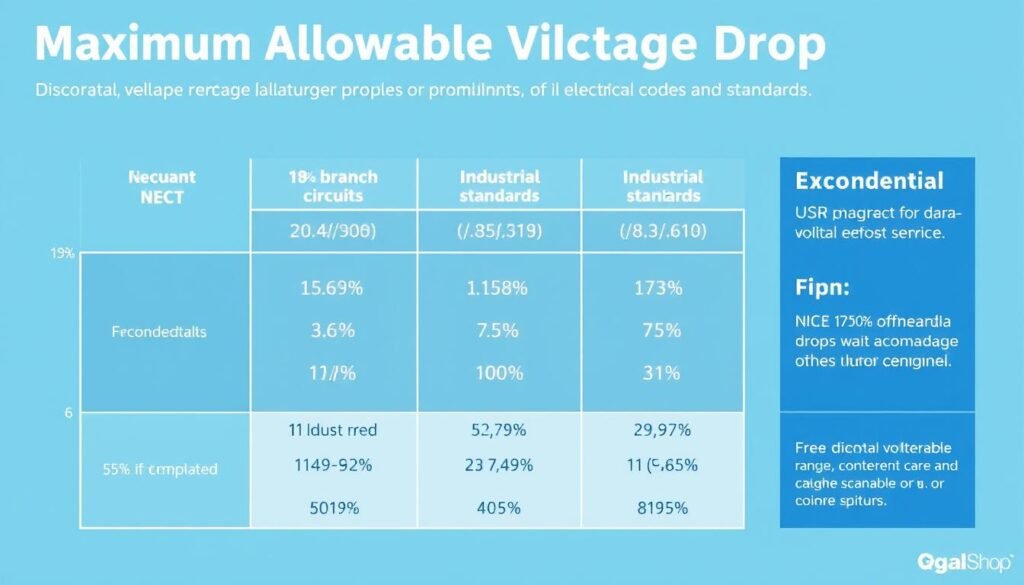
Electrical codes and standards specify maximum allowable voltage drop to ensure safe and efficient operation of electrical systems:
| Standard/Application | Maximum Voltage Drop | Notes |
| NEC Branch Circuits | 3% | Recommended for optimal performance of connected equipment |
| NEC Feeder + Branch Circuit | 5% | Combined total from source to final load |
| Residential Lighting | 2% | Prevents visible dimming and flickering |
| Motor Circuits | 3% | Prevents reduced torque and overheating |
| Critical Equipment | 1-2% | Medical, data centers, and safety systems |
| Long Distance Runs | 3-5% | Outbuildings, landscape lighting, etc. |
Exceeding these recommended limits can lead to equipment malfunction, reduced efficiency, increased energy costs, and potential safety hazards. Always consult local electrical codes, as requirements may vary by jurisdiction and application.
Frequently Asked Questions
What is an acceptable voltage drop?
The National Electrical Code (NEC) recommends a maximum voltage drop of 3% for branch circuits and 5% for the combined feeder and branch circuit. However, acceptable voltage drop can vary depending on the application. For critical equipment or sensitive electronics, a lower voltage drop (1-2%) may be necessary. For general lighting and power circuits, 3-5% is typically acceptable.
Does voltage drop affect power consumption?
Yes, voltage drop increases power consumption. When voltage drops, many devices (particularly those with motors) will draw more current to maintain the same power output, which increases energy consumption. Additionally, the voltage drop itself represents energy that is wasted as heat in the conductors. This wasted energy is calculated as P = I² × R, where I is the current and R is the resistance of the wire.
How does voltage drop differ between AC and DC?
In DC circuits, voltage drop is caused solely by the resistance of the conductor. In AC circuits, voltage drop is caused by both resistance and reactance (the opposition to current due to inductance and capacitance). This means that AC voltage drop calculations must consider the impedance (Z), which is the vector sum of resistance and reactance. Additionally, in three-phase AC systems, the voltage drop formula includes a factor of √3 (approximately 1.732).
What is the voltage drop for a 12-gauge wire?
The voltage drop for a 12-gauge copper wire depends on the current and length. A 12 AWG copper wire has approximately 1.588 ohms of resistance per 1000 feet at 75°C. For a 100-foot run carrying 15 amps, the voltage drop would be approximately 4.8 volts in a DC or single-phase AC circuit. This equates to a 4% voltage drop in a 120V system, which exceeds the NEC recommendation of 3% for branch circuits.
Can voltage drop cause equipment damage?
Yes, excessive voltage drop can damage equipment. Motors may overheat and burn out due to increased current draw. Electronic equipment may malfunction or fail prematurely when operating below rated voltage. Heating elements will produce less heat, causing equipment to run longer to achieve the desired temperature. Additionally, voltage drop can cause voltage-sensitive equipment to reset or operate erratically.
How do I convert AWG to circular mils?
The cross-sectional area in circular mils (CMA) for a given AWG size can be calculated using the formula: CMA = 0.025 × 92(36-n)/19.5, where n is the AWG number. Alternatively, you can use a wire size chart. For example, 12 AWG wire has approximately 6,530 circular mils, 10 AWG has 10,380 circular mils, and 8 AWG has 16,510 circular mils.
Does ambient temperature affect voltage drop?
Yes, ambient temperature affects voltage drop because the resistance of a conductor increases with temperature. Standard voltage drop calculations typically assume a conductor temperature of 75°C (167°F). In high-temperature environments, the actual voltage drop may be higher than calculated. For every 10°C increase in temperature, the resistance of copper increases by approximately 4%, which proportionally increases the voltage drop.
Need More Help With Electrical Calculations?
Our voltage drop calculator takes the guesswork out of electrical design. Create a free account to access this and other helpful tools.
Conclusion

Accurate voltage drop calculation is a fundamental aspect of electrical system design and maintenance. By understanding the causes and effects of voltage drop, you can ensure your electrical systems operate safely, efficiently, and in compliance with relevant codes and standards.
Remember that voltage drop increases with circuit length, current load, and wire resistance, and decreases with larger wire sizes. Always consider voltage drop when designing new electrical systems or troubleshooting performance issues in existing installations. When in doubt, consult with a qualified electrician or electrical engineer to ensure your system meets all applicable requirements.
By applying the formulas and principles outlined in this guide, you can confidently calculate voltage drop for various applications and make informed decisions about wire size selection, circuit layout, and load distribution. This knowledge is invaluable for electricians, engineers, contractors, and DIY enthusiasts working on electrical projects of any scale.