Use our VAT Calculator to quickly add or remove Value Added Tax from any amount. Get accurate VAT calculations for business or personal use.
Welcome to our comprehensive VAT calculator tool. Whether you’re a business owner calculating invoice amounts, a consumer wanting to understand tax components, or an accountant verifying figures, our calculator provides accurate VAT calculations for multiple countries and rates. Simply enter your values below to instantly add or remove VAT from any amount.
VAT Calculator Tool
Please provide any two values to calculate the remaining value. Select your country to automatically apply the standard VAT rate, or manually enter a custom rate.
| Description | Amount |
| Net Amount (excl. VAT) | 0.00 |
| VAT Amount | 0.00 |
| Gross Amount (incl. VAT) | 0.00 |
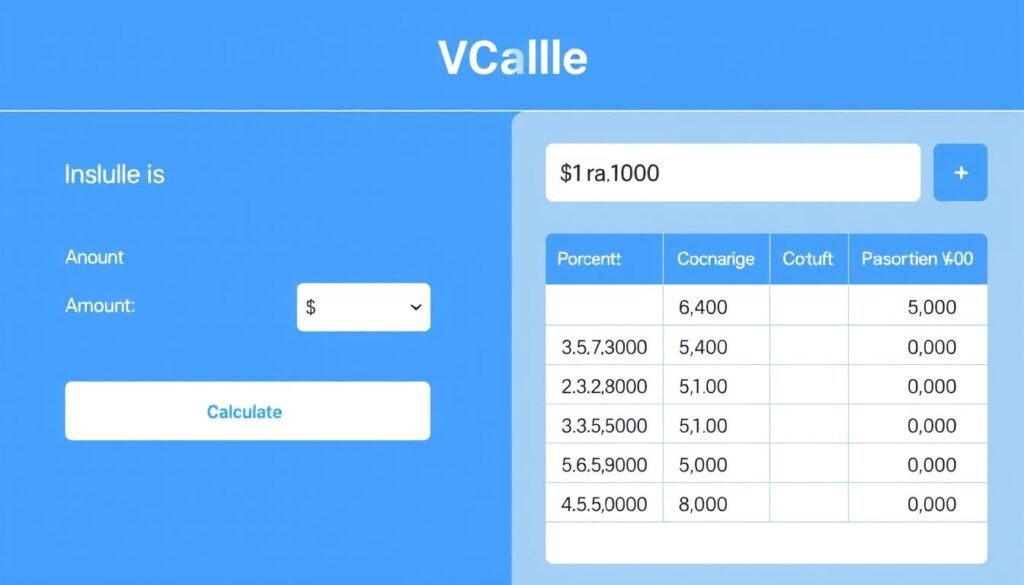
Our VAT calculator provides instant results for any amount and rate
What is VAT and How Does It Work?
Value-Added Tax (VAT) is a consumption tax placed on products and services whenever value is added at each stage of the supply chain, from production to the point of sale. Unlike a simple sales tax that’s only applied at the final stage of a transaction, VAT is collected by all businesses involved in the production process.
Key VAT Concepts
- VAT is charged at each stage of production and distribution
- Businesses collect VAT from customers and pay it to tax authorities
- Businesses can reclaim VAT they’ve paid on purchases
- End consumers bear the final tax burden
- VAT is used in more than 160 countries worldwide

VAT vs. Sales Tax: Understanding the Difference
| Feature | VAT | Sales Tax |
| Collection Point | Multiple stages (production, wholesale, retail) | Single stage (final sale only) |
| Who Pays | Each business in supply chain, ultimately consumer | End consumer only |
| Tax on Tax | No (input tax credit prevents cascading) | Possible in multi-stage systems |
| Typical Rates | 15-27% (higher) | 4-10% (lower) |
| Compliance | More complex paperwork | Simpler for businesses |
Did you know? The United States is the only major developed country that doesn’t use a national VAT system, instead relying on state and local sales taxes.
How VAT Works: A Practical Example
To understand how VAT functions in practice, let’s follow a product through its supply chain. This example demonstrates how VAT is applied at each stage while preventing double taxation.
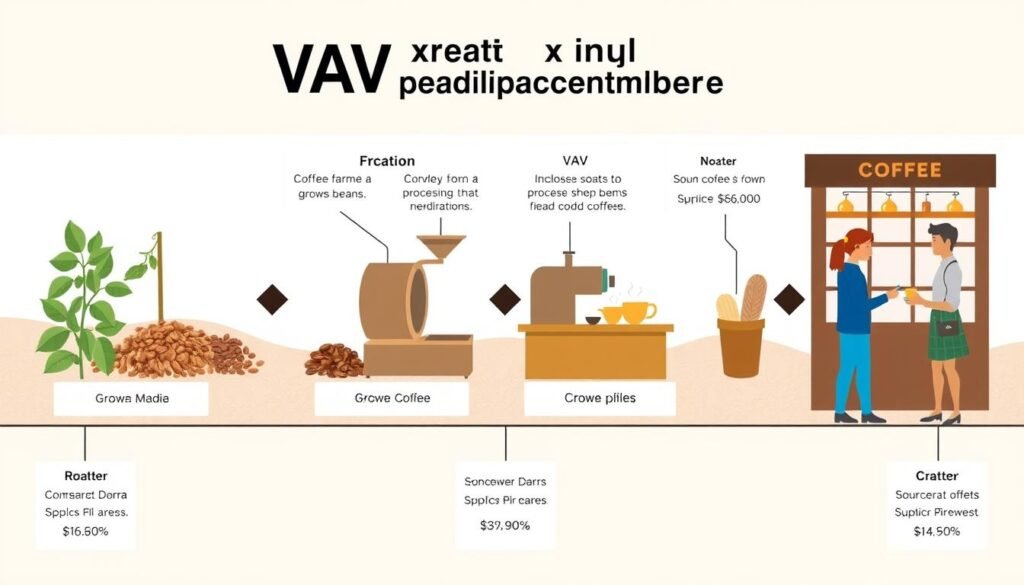
Coffee Production VAT Example (10% VAT Rate)
Stage 1: Farmer
The farmer sells coffee beans to a roaster for $5.00.
- Net price: $5.00
- VAT charged (10%): $0.50
- Roaster pays: $5.50
- Farmer pays to government: $0.50
Stage 2: Roaster
The roaster processes beans and sells to a coffee shop for $10.00.
- Net price: $10.00
- VAT charged (10%): $1.00
- Coffee shop pays: $11.00
- Roaster pays to government: $0.50 ($1.00 collected minus $0.50 already paid)
Stage 3: Coffee Shop
The coffee shop makes 5 cups at $4.00 each ($20.00 total).
- Net price: $20.00
- VAT charged (10%): $2.00
- Customers pay: $22.00
- Coffee shop pays to government: $1.00 ($2.00 collected minus $1.00 already paid)
In this example, the total VAT paid to the government is $2.00 ($0.50 + $0.50 + $1.00), which is exactly 10% of the final value of the product ($20.00). Each business only pays the tax on the value they add to the product.
VAT Rates Around the World
VAT rates vary significantly across countries and regions. Some countries apply a single rate to all goods and services, while others use multiple rates depending on the product category. Here’s an overview of standard VAT rates in different regions:
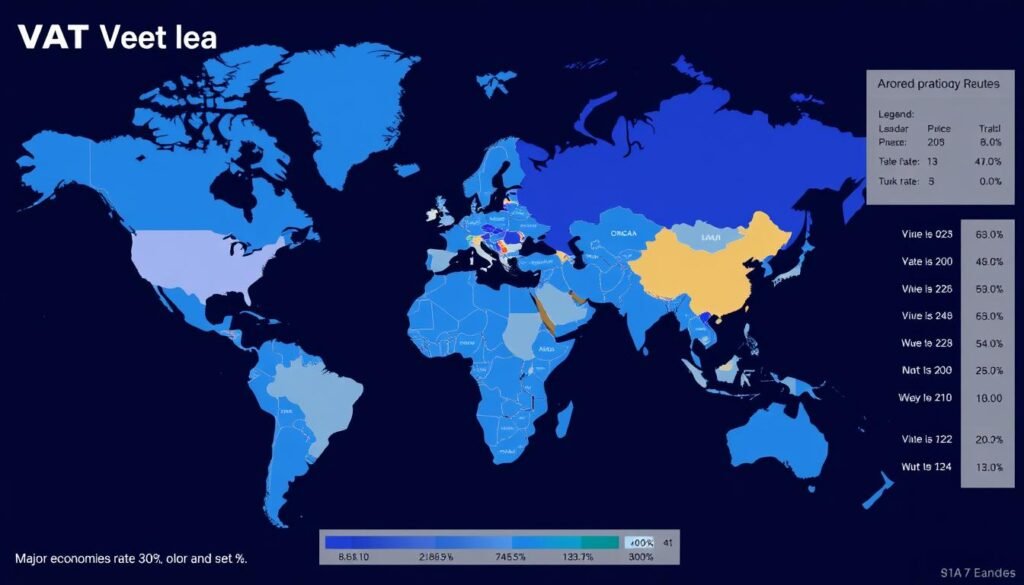
| Region/Country | Standard VAT Rate | Reduced Rates | Notes |
| United Kingdom | 20% | 5%, 0% | 5% for home energy, children’s car seats; 0% for food, books, children’s clothes |
| European Union | 15-27% | 5-18%, 0% | Minimum standard rate of 15%; varies by member state |
| Australia (GST) | 10% | 0% | Called Goods and Services Tax; 0% for basic foods, health, education |
| Canada (GST/HST) | 5-15% | 0% | Federal GST (5%) plus provincial taxes; varies by province |
| Japan | 10% | 8% | 8% for food and beverages (excluding alcohol) |
| United States | N/A | N/A | Uses sales tax instead; varies by state (0-9.55%) |
Important: VAT rates can change. Always verify the current rates with official government sources before making business decisions or financial calculations.
Many countries offer exemptions or zero-rated status for essential goods like basic foodstuffs, children’s clothing, books, and medical supplies. This helps reduce the regressive nature of VAT, which can disproportionately affect lower-income households.
How to Calculate VAT: Formulas and Methods
Calculating VAT can be done in two primary ways: adding VAT to a net amount or removing VAT from a gross amount. Our calculator handles both methods automatically, but understanding the formulas helps you verify calculations.
Adding VAT to a Net Amount
To calculate the total price including VAT from a net amount:
Gross Amount = Net Amount × (1 + VAT Rate)
VAT Amount = Net Amount × VAT Rate
Example (20% VAT):
- Net Amount: $100
- VAT Amount: $100 × 0.20 = $20
- Gross Amount: $100 × 1.20 = $120
Removing VAT from a Gross Amount
To calculate the net amount and VAT from a gross (total) price:
Net Amount = Gross Amount ÷ (1 + VAT Rate)
VAT Amount = Gross Amount – Net Amount
Example (20% VAT):
- Gross Amount: $120
- Net Amount: $120 ÷ 1.20 = $100
- VAT Amount: $120 – $100 = $20
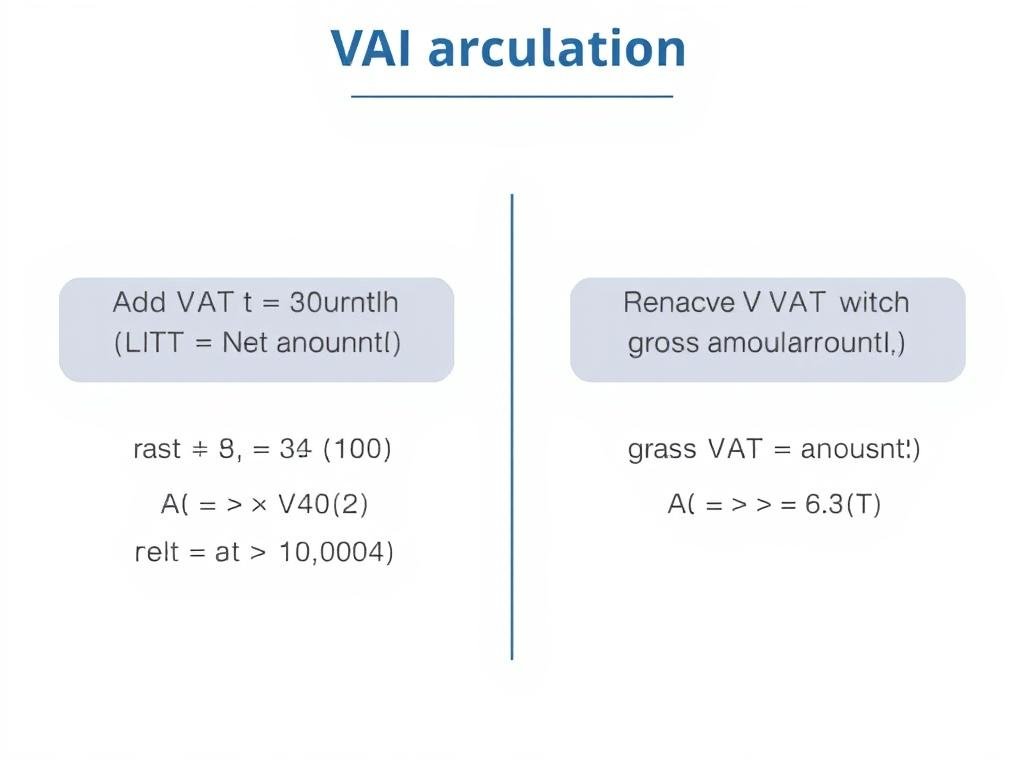
Common VAT Calculation Examples
| Net Amount | VAT Rate | VAT Amount | Gross Amount |
| $1,000.00 | 20% | $200.00 | $1,200.00 |
| $500.00 | 20% | $100.00 | $600.00 |
| $200.00 | 20% | $40.00 | $240.00 |
| $1,000.00 | 5% | $50.00 | $1,050.00 |
| $1,000.00 | 10% | $100.00 | $1,100.00 |
VAT for Businesses: Key Considerations
For businesses, understanding VAT regulations and requirements is essential for compliance and financial planning. Here are important considerations for businesses dealing with VAT:
VAT Registration
Most countries require businesses to register for VAT once their turnover exceeds a certain threshold. For example:
- UK: £85,000 in any 12-month period
- EU: Varies by member state (€10,000-€100,000)
- Australia: AUD 75,000 annually
Businesses below the threshold may voluntarily register to reclaim VAT on purchases.

VAT Compliance for Businesses
Record Keeping
- Maintain all sales and purchase invoices
- Keep VAT records for required period (typically 6-7 years)
- Ensure invoices include all required VAT information
- Use accounting software with VAT tracking capabilities
VAT Returns
- Submit VAT returns regularly (usually quarterly)
- Pay collected VAT minus input VAT
- Meet filing deadlines to avoid penalties
- Consider digital filing requirements (e.g., Making Tax Digital in UK)
International Considerations
- Understand place of supply rules
- Apply reverse charge mechanism when applicable
- Register for VAT in countries where required
- Consider VAT implications for e-commerce sales
Pro Tip: Many businesses find it beneficial to consult with a tax professional who specializes in VAT to ensure full compliance and identify potential savings opportunities.
Common VAT Calculation Mistakes to Avoid

- Applying incorrect VAT rates – Always verify the current rate for your specific goods or services
- Calculating VAT on gross instead of net – Remember VAT is calculated on the pre-tax amount
- Rounding errors – Use consistent decimal places throughout calculations
- Failing to adjust for partial exemptions – Some businesses can only reclaim a portion of input VAT
- Misunderstanding international VAT rules – Cross-border transactions have special considerations
Frequently Asked Questions About VAT
What is the difference between VAT and GST?
VAT (Value-Added Tax) and GST (Goods and Services Tax) are essentially the same type of consumption tax with different names. Both are applied at multiple stages of production and distribution. Countries like Australia, Canada, India, and Singapore use the term GST, while European countries typically use VAT. The implementation details, rates, and specific regulations may differ, but the fundamental concept is the same.
Do I need to charge VAT on exports?
In most countries, exports are zero-rated for VAT purposes, meaning you don’t charge VAT on goods or services exported outside your country or region (like the EU). However, you can still reclaim any VAT you paid on costs related to those exports. This system prevents double taxation and makes exports more competitive. Always check the specific rules for your country and the destination country, as documentation requirements vary.
How do I reclaim VAT as a business?
VAT-registered businesses can generally reclaim the VAT they pay on purchases related to their taxable business activities. To reclaim VAT:
- Keep all valid VAT invoices and receipts
- Record input VAT (VAT paid on purchases) in your accounting system
- Complete regular VAT returns, subtracting input VAT from output VAT (VAT charged on sales)
- Submit returns to your tax authority by the deadline
Note that some expenses may have restrictions on VAT recovery, such as business entertainment or certain vehicle costs.
Why doesn’t the United States use VAT?
The United States is the only major developed country without a national VAT system. Instead, it relies on state and local sales taxes. There are several reasons for this:
- Historical preference for state-level taxation
- Political resistance to implementing new federal taxes
- Concerns about the regressive nature of consumption taxes
- Administrative complexity of transitioning to a new system
Periodically, economists and policymakers debate the potential benefits of implementing a VAT in the US, but so far, sales tax remains the primary consumption tax.
Simplify Your VAT Calculations
Understanding and calculating VAT correctly is essential for businesses and consumers alike. Our VAT calculator tool makes this process simple and error-free, helping you:
- Quickly add VAT to net amounts for invoicing
- Accurately remove VAT from gross amounts for accounting
- Apply the correct VAT rates for different countries and product categories
- Save time on manual calculations and reduce errors
Start Using Our VAT Calculator Today
Simplify your tax calculations with our free, accurate, and easy-to-use VAT calculator.
For more financial tools and calculators, explore our complete collection at CalculatorHunt.com. Our mission is to provide accurate, user-friendly calculators for all your financial, mathematical, and everyday calculation needs.